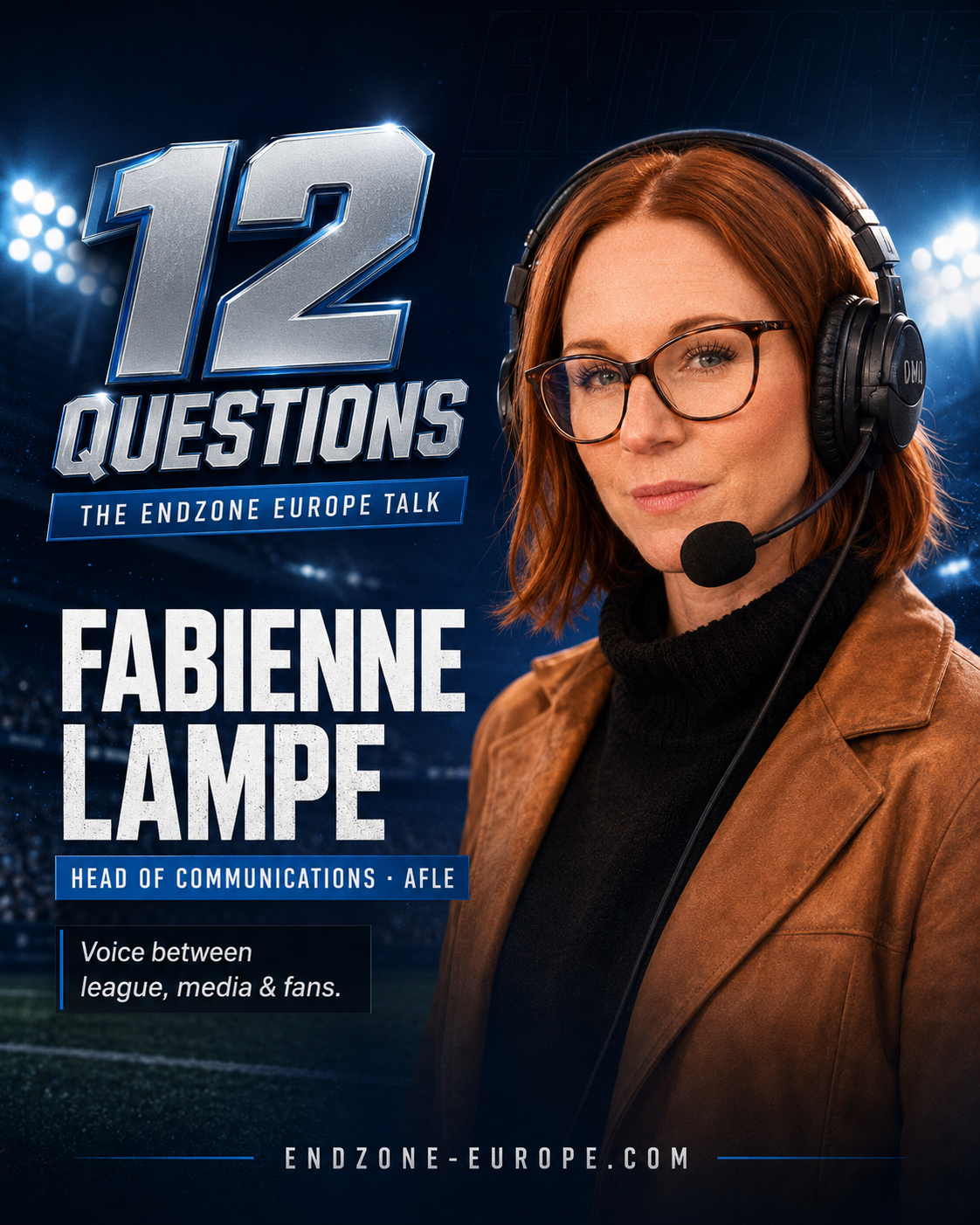
As Head of Communications, Fabienne Lampe has been shaping the public voice of the AFLE from the beginning. In this interview, she explains why trust is the foundation of a new league, how much work sits behind posts, press releases, statistics and streaming, and why real stories matter more than pure marketing messages.
Fabienne, you are Head of Communications of the AFLE and therefore a central connection between the league, media, teams and fans. How would you describe your role in a few words – and what makes it special for you?
As Head of Communications, I am not only the voice of the league, but also the link to the outside world with media and fans, and internally to the individual teams. What truly carries this work is trust. You have to earn it, and after everything that happened in European American football last year, it has to be rebuilt. I take that very seriously.
What makes this role and my work for the AFLE special is that we are writing American football history here. In the background, our team built a playable league within six months, and I get to be part of it from the beginning and help shape how the AFLE is perceived through communication. The fact that I can also follow my love for sports writing and write articles for the website makes it perfect for me.
Many fans mainly see games, results, posts and press releases in the end. What happens behind the scenes to make a league like the AFLE appear professional, understandable and approachable?
Behind every post, every press release and every newsletter, there is a lot of coordination between different departments. Sometimes with the editorial team, sometimes with the media team, marketing or football operations. We coordinate very closely because every message goes out through different channels and everything has to fit together. We support each other, work well together and know that we can rely on one another. Without all of that, this pace would not be possible.
At the same time, we are building all the structures in the background that a professional league needs: there is an officiating department, complete statistics on our website and, with AFLE+, our own streaming service, which we developed and launched from the ground up. Those are not things to be taken for granted, especially not in a league that is only half a year old.
We also create approachability by telling stories away from the field and by being contacts on site during gamedays. At the Media Day in Vienna, we deliberately worked with players and coaches, did challenges and showed another side of the players away from the field. Professionalism and approachability do not exclude each other. Together, they are what we want to stand for.
The AFLE is a new project in European football. New leagues often create curiosity, but also many questions. How important is good communication in building trust with fans, media and clubs?
For me, good communication is not just a tool in everyday life. At the AFLE, it is actually the foundation on which we want to build long term. People do not know us yet. They do not have ten years of experience with us. So every piece of communication helps decide whether people believe us or not.
For fans, media and teams, the core is the same: everyone wants to feel that we are being honest with them. Fans do not want to feel that we are only selling highlights. Media need reliable contacts and clean information, and the teams have decided to be part of this league. So they need to feel that their interests are being heard, not only externally, but also internally.
What has been the moment so far when you realized: yes, the AFLE is being noticed and is creating something in the football community?
Marshawn Lynch was at the season opener in Vienna on May 23, 2026. And he was there because European American football is being noticed. Because the AFLE is on the radar of people who have dedicated their lives to American football. The reaction from the community really moved me. People came for a meet and greet, and the excitement was tangible. In that moment it was clear: this is more than a niche project. When former NFL players start looking toward Europe, then our league is on the right path.
You are not only working in communications, you also have a strong media and football background yourself. How does that experience help you today when you communicate content, messages and stories around the league?
That is true. American football is not a new world that I have now entered through communications. I grew up with this wonderful sport. All the experiences I have collected both as a fan and professionally are my daily tools in my work today.
As a German beat writer for the Atlanta Falcons, I learned how to write about American football, not only for insiders, but for people who may not know every play yet but want to feel what makes this sport special. That helped me understand how American football works away from the field, which stories want to be told and how close you have to be to the community. That helps me enormously today. I know what journalists need because I work in sports journalism myself. I know how fans feel because I am one. And I know that good football communication does not end with results. That is where it begins.
American football in Europe is strongly driven by emotions, community and identification. Which stories around players, teams or fans should be told much more often in your opinion?
The stories that move me the most happen away from the field. Who is this player when he is not training? What brought him to football? What job does he do during the week before he steps onto the field on the weekend?
In many cases, European American football is not yet a full-time job. That means behind every athlete there is a person with a real life beside the sport. That is exactly what makes football in Europe so special and so approachable. We still tell these stories far too rarely.
The same is true for fans and communities. There are people who have been building local teams for years and coaching children without anyone talking or writing about it. But that is the foundation that made a league like the AFLE possible in the first place. American football in Europe lives from these stories. We just have to tell them. That is what we have committed ourselves to at the AFLE.
Communication in sports is often a balancing act: you want to create excitement but remain credible at the same time. How can a league be presented positively without sounding like pure marketing?
For me, the difference between excitement and marketing is attitude. We are not selling a finished myth; we are showing how one is being created. That is more honest, and people can feel it.
In concrete terms, that means we do not only talk about success. We also show the build-up, the work behind it and the people and partners who make this league possible. If a game was close and the underdog won, we tell that story not because it looks good for the league, but because it is the truth. And the truth is usually the better story.
Credibility also comes from not wanting to control everything. Our creators have their own voices, and the teams have their own identities. We provide the framework, but we let real personalities speak. That protects us from sounding like a PR machine.
The AFLE wants to help develop football in Europe. From your point of view, what makes the league different from other projects – and where is its biggest opportunity?
What really sets the AFLE apart from other projects for me is its attitude toward the teams. We do not leave the franchises on their own. The investor supports them financially, but we also help with operational, communications and media questions. That is our job as a league: not just to set the framework, but to make sure that the teams can really function within it long term.
And the biggest opportunity? We are a restart, with everything that means. We can avoid mistakes that others have made. We can make American football in Europe bigger than it already is. The potential is there, the passion is there, the community is there. Now we just have to do it right.
Transparency matters to many fans: schedules, broadcasts, decisions, developments. What can leagues do better today to truly bring fans along?
Schedules, broadcasts, important news and further information are things people want to be able to access reliably. If they cannot, you quickly lose them as fans. That is why it is important for us not to leave fans in the dark.
Admittedly, before season kickoff we were late in communicating some things. But that has to do with a reality not many leagues know: within six months we built something like a complete all-in package. Game operations, social media, streaming, communications, statistics – everything at the same time and from zero. Before we could communicate certain things, the contractual and legal framework had to be in place.
But whenever possible, we want to communicate earlier in the future, even if not everything is finished yet. Fans are much more likely to forgive delays if they feel they are being taken along. What they do not forgive is silence.
Women in football are becoming more visible – in media, coaching, management, communications and on the field. How do you personally experience this development, and what do you wish for the coming years?
I experience this development as thoroughly positive, and I do not say that as an empty phrase. When I see how many women are active in American football today in many different roles, that is real change. What I wish for the coming years is more togetherness. Women are not taking anything away from men in this sport; we are adding something. More perspectives, more stories, more people who can identify with this sport. That should not threaten anyone.
Still, you repeatedly read insults as soon as women in sports move into the spotlight. Honestly, that is what concerns me the most. Not the question of whether we have a place, because we do. The question is why it is still a problem for some people.
Looking five years ahead: where should the AFLE stand by then – sporting-wise, media-wise and in the perception of fans?
In five years, I want people to stop looking at you strangely on the street when you talk about American football in Europe. That sounds simple, but for me it is the most honest measure that the sport has finally arrived.
From a sporting perspective, I want full AFLE stadiums, goosebump moments and a league that has continued to grow, but carefully. New teams, new countries, more reach: yes. But only when the stability is there.
In five years, I also want to see homegrown players who have made the jump from the AFLE to the NFL. For me, that would be the ultimate proof that we have taken the level of play to where it belongs: right at the top.
From a media perspective, with AFLE+ we have already built something that thinks far beyond Europe. American football is almost sacred in the United States, and I believe there is genuine curiosity to experience this sport in its European form as well. In five years, I want us to have used that opportunity and excited people around the world about what we are building here.
To close: if you could give one message to the fans of American football in Europe, why should they give the AFLE a real chance and follow this journey?
I say this as someone who has loved American football for 27 years: what is happening here right now is something special.
European American football has a history, and the AFLE is its next chapter. We grew out of a movement that proved this sport works in Europe. Now we are taking the next step. We are young, we still have a lot ahead of us, and that is exactly why now is the right moment to be part of it. Not just as a spectator, but as part of this story.
A big thank you to Fabienne Lampe for her open and detailed answers. Her view behind the scenes shows how much communication, structure, passion and trust are needed for a new football league in Europe to grow.