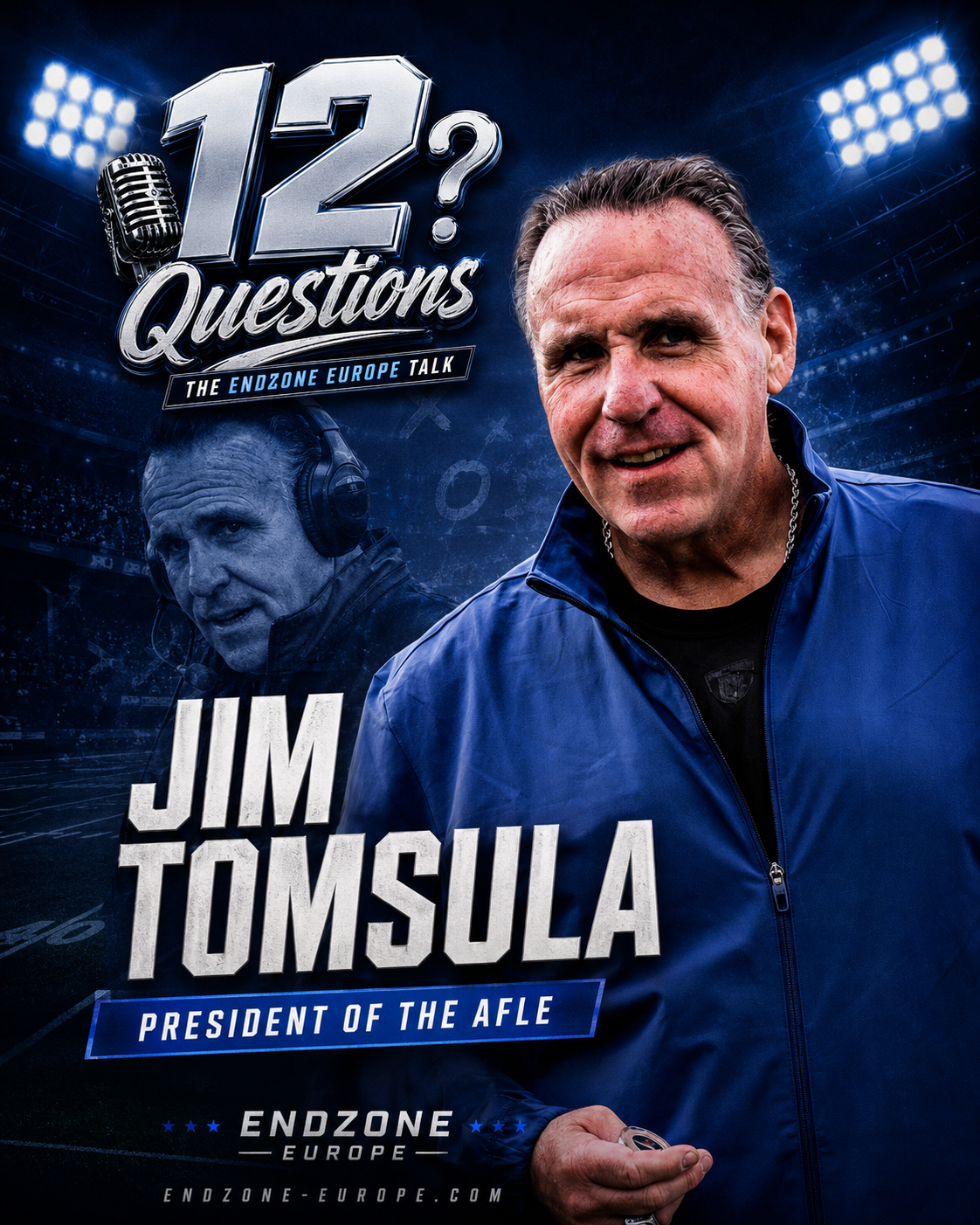
From NFL Europe to the NFL and back-to-back championships with Rhein Fire, Jim Tomsula knows football from almost every perspective. In this extensive 12 Questions interview, he explains why trust has to be earned, why honesty and transparency are essential for the AFLE and how a league can be built that connects teams, players, coaches, fans and communities for the long term.
Jim, from NFL Europe to the NFL, from Rhein Fire back to European football and now to the AFLE — what keeps bringing you back to football in Europe?
It’s where we started. My wife and I just love it. We love American football in Europe. We love the fans; we love the way everything works together. You can’t forget where you started. I started with the NFL Europe years ago, when we were a young family and we spent 10 years travelling all over Europe. Then I worked for the NFL. I just fell in love with the game from a perspective of the people in Europe. We are very grateful. Now it’s time to get back. I just have this passion to make football sustainable in Europe, to make pro-football in Europe a sustainable and exciting game.
You have just been appointed President of the AFLE. When you look at this new role, what is the first thing you want people to understand about your mission?
First of all: it’s not my passion, mission or vision; it’s our passion, vision and our mission. It’s all of us working together – the fans, the players, the coaches, all the volunteers and the staff, the front office, and ownership. It’s all of us working together and becoming great pillars in our community. We want to be great community members and neighbors, we want to build teams, that represent our fanbase, our communities and then represent European American football as a whole.
The AFLE talks about building something bigger, better and more sustainable. In your eyes, what does European football need most right now: better coaching, stronger franchises, more player development, or more trust?
It’s our first year. We’re still in the startup phase. The number one thing is trust. The fans need the trust, the coaches need the trust, and the front office needs the trust. Trust isn’t given, it’s earned. We’ve got to open the door a little bit and let people earn the trust. And then we build relationships. The game of football is all about the people that are in it, and all of us working together. It’s going to be good, we’re going to be able to have fun with this. We’re all going to be able to have passion about it. The media, they are part of it. They get the message out. It gives them things to write about. We just gotta work together and be honest when there is a problem. Then we admit the problem, talk about the solutions, come to the solutions, and then we move forward.
You built a championship culture with Rhein Fire and won back-to-back titles in 2023 and 2024. What are the most important ingredients when you try to build a winning culture from the ground up?
It starts with trust. Teamwork. Collaboration. Everybody rolling in the same direction. The players on the field, that’s the game. That’s what we’re all surrounded by. It just brings people together. Fans are friends. Football is family. I mean, those are the fans that come up with these statements. And it couldn’t be truer. And that’s what’s so special about football in Europe. As we keep growing, everybody brings somebody to the game. Everybody lets somebody else experience it. We just keep growing together. There are some fans that learn the game of football at the football games. You don’t need to know all the rules or schematics; you just come to the games and the people next to you will help you and you learn together.
We put the system and the structure in place. And we’ve organized efficient lines of communication, efficient lines of working together. We’re honest with each other. We’re honest with players, when they’re coming to play in our teams. We want integrity. We want to be able to do things the right way. There are going to be bumps on the road. We have to be able to identify those and to fix them, we’ve got to be able to adapt and adjust and keep moving forward.
You have coached in the NFL, in NFL Europe, and in modern European football. What is the biggest difference between coaching American players in the U.S. and developing players in Europe?
Well, as far as the people go, and the players go and coaching goes … coaching is coaching, players are players. We’re all doing our job together. I don’t see a big difference there. It’s making sure that the coaches that have a lot of experience are sharing it with the coaches that maybe don’t have the experience. Then it’s making sure we take care of the players. It’s a player’s game; we have to be able to take care of them. They don’t care about how much you know, until they know how much you care.
The biggest difference is the culture in America. It’s built around football. From a very young age, everybody is experiencing football, it’s all around them, they’re swamped with it. Then they get to the facilities, see all the gadgets. That’s not as prevalent in Europe yet, but it’s not necessary to build something great.
Player development is one of the key topics connected to your new AFLE role. What must happen so that more European players can become truly high-level football players?
It’s a real big deal, it’s a focus, an emphasis of what we’re doing. That’s why we’re getting into the communities, why we’re working with the youth. Everybody that’s involved in football, we’re going to be a part of it. If they wanna have us: we will be there. We will help where we can. We want people to experience a great game. There is a place for everybody in American football. The big guys, the little people, the fast people. If you don’t want to be on the pitch, you can be in the equipment room, you can work in PR. We want to bring everybody in. We’ll work with the flags; we will help with the development of those things.
You are known as a coach who is very close to his players and who cares deeply about teaching the game. What does “coaching the right way” mean to you?
Well, I mean coaching the right way is caring. Caring for the kids, caring for the athletes, teaching them, taking the time, having the patience, helping them achieve. There is no greater feeling in the world.
European football has gone through a lot of change, emotion and uncertainty in recent years. What does the AFLE have to do to earn long-term trust from teams, players, coaches and fans?
There have been ups and downs. There have been highlights and low points in this journey of the professional American football in Europe. To me, it’s honesty, it’s transparency. When you make a mistake, let people know what we’re going to do to fix these mistakes, and then do it. It’s always in your actions. It’s not talking about it, it’s doing it. You don’t just get trust. You have to earn trust. We ask everybody to open the door a little, but let us earn your trust, and we’re going to stay consistent. We’re going to have a plan, we’re going to stick to that plan, we have to adjust and adapt and we have to be able to communicate.
You worked in NFL Europe years ago, when names like Rhein Fire, Berlin Thunder and Scottish Claymores helped shape the sport on this continent. What did that era teach you that still matters today?
I worked for those teams; they gave me an opportunity. I learned my craft in Europe, all around the people in Europe. I was hired to the NFL from NFL Europe – so I was in Europe and was hired to San Francisco. This is where we learned it, and it means everything to us. That’s why my wife and I are back here. We’ve always been passionate about the idea of making this work. We’re grateful for what we gained in experiences, the people we met, the fans. We’re here, and that’s what it means to us. It started a journey for us that has been nothing short of phenomenal.
Many fans in Europe dream about a professional football structure that can last for decades. What would make you say in five years: “Yes, we are on the right path”?
Sustainability obviously starts with the people. It’s the fans, it’s the players, the front office – it’s everybody involved. We all have to work together. We have the media, the outlets. We have to be able to let our media in. When they have questions or want to be educated on something we’re doing, we have to be able to share. That’s how we’re going to grow this thing together.
Giving good quality games, exciting games for people – so people have a great time and memories are made. No hooligans – it’s a family experience. We want our fans to be able to come with their children, and their grandparents. We want everybody to join and have a great day. That would make me say we’re on the right path.
When young European coaches look at your career, from position coach to NFL head coach to league president, what advice would you give them?
The first thing I would say is follow your dreams and follow your passion. You have only one life to live, so live it to the fullest. No one out of my family was in pro football or in pro sports. There were a million reasons why I shouldn’t, why I couldn’t. There was also one little belief that was “Why not? Why not me?” Just go do it, and learn it, and work hard at it, and if you’re passionate about it, you will, and you’ll see where it goes. Success isn’t measured by how many dollars you have in the bank, or if you are on the biggest stage in the world. That’s not success. Success is fulfillment and being fulfilled. It’s a life worth living. Some of the most successful coaches I’ve met are coaching in Europe. They’re affecting young people, they’re good role models, they make a difference in people’s lives.
Finally, when fans hear the name Jim Tomsula connected with the AFLE, what should they expect from you personally — and what kind of league do you want to help build?
In my opinion, the word “I” doesn’t belong into this answer. We all build this thing, we all work together, we all do this together. We are excited about it, and we’ll make something special. In terms of the league itself: honesty, integrity, transparency. Being honest. Admitting mistakes, coming together and finding solutions. You can only find solutions, when you’re honest with yourself. When we all do it together, we’re not going to fail. This is going to work, and I believe it in my heart. And we’re going to make mistakes. If you’re not making mistakes, you’re not trying hard enough. We’re going to be structured, we’re going to have systems in place, but we’re not going to be rigid. We’re going to be able to adapt. When you have everybody involved, there are going to be a lot of ideas, but obviously you can’t do them all. But you’re always looking to find the best one and run with it. As you build your team in training camp, keep getting better every day.
This year there are some rough patches, and we’re going to fight through it and keep going. But when you look at it, ownership decided there would be a season this year, and it got started late because of all the things that were going on. That’s hard, it’s hard to fight through, but we’ll keep fighting through it. We’re going to end this season on an upswing and keep moving forward, while we’re planning for next year.
Many thanks to Jim Tomsula and to Fabienne Lampe for coordinating this interview. His answers make clear what he wants the AFLE to be built on: trust, integrity, transparency, community and the commitment to get better every day.