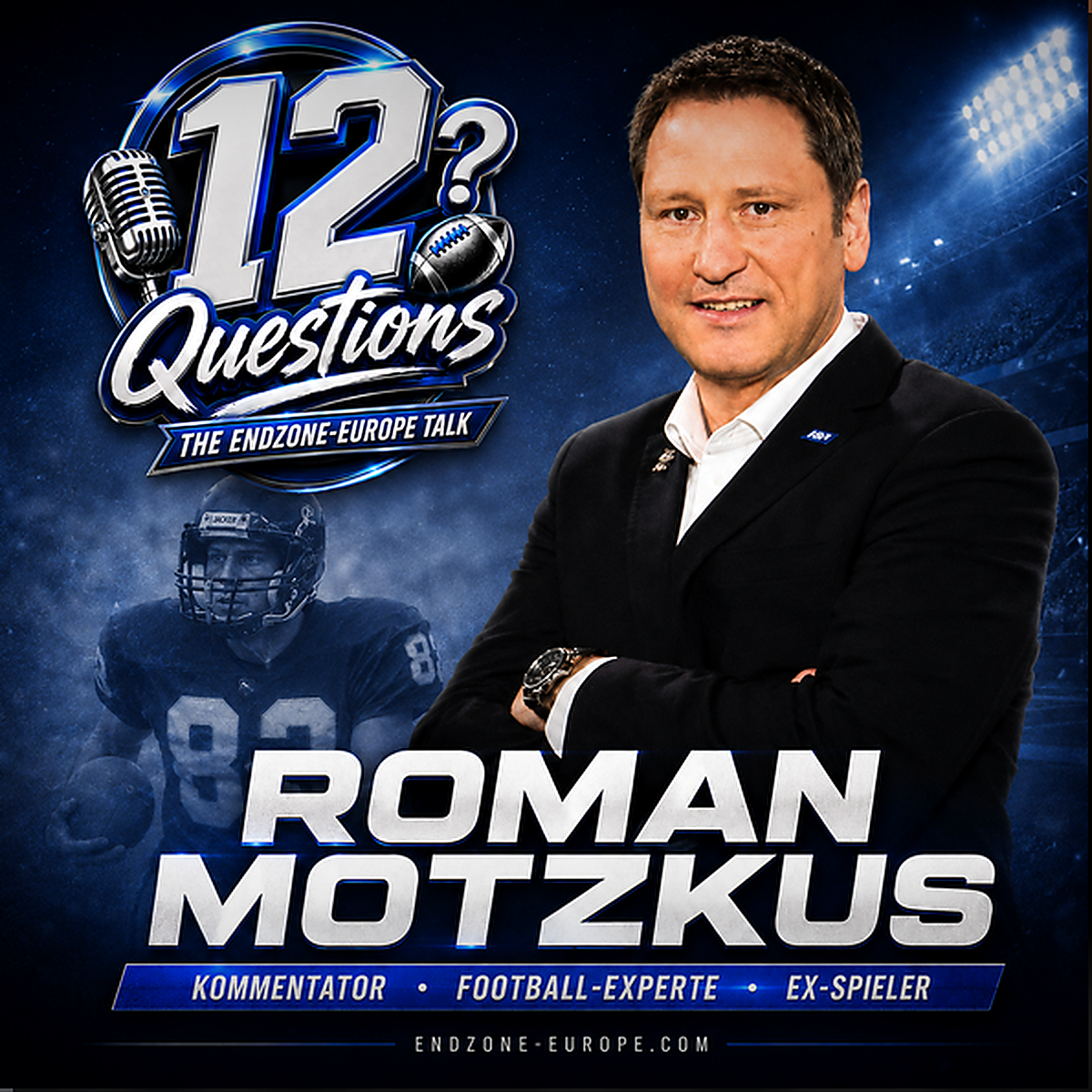
A conversation with one of the best-known voices in German football: Roman Motzkus looks back on his playing days, his media work and the current development of the sport in Germany and Europe.
Roman, you have been one of the well-known faces and voices of German football for many years. Looking back today, what was the moment when American football became more than just a sport for you?
It was not one specific moment. It already started during my active playing career, when Premiere approached me in 1990/91 to help with their football broadcasts. At first I worked as an adviser, then quite quickly also as a presenter and editor. That was when I quickly realised that football was more than just a hobby for me. Since then, the sport has shaped my life.
You played yourself, including for the Berlin Adler, and later followed the sport from a media and expert perspective. How much does your own playing experience still help you today in your work as a commentator and expert?
It always helps when you do not just look at things from the outside, but can speak from experience. What thoughts go through your mind as a player, coach or official in certain situations. And how you deal with pressure, for example before a final. Also how you deal with success and setbacks. If, for example, you have to recover from a serious injury and actually want to be back on the field long before you are ready, or what it feels like to return to the field after such an experience – that is something an outsider can only understand with difficulty.
Many fans know you mainly from NFL broadcasts. What makes a good football broadcast for you – expertise, emotion, entertainment or the right mix of everything?
First and foremost, it should be about the sport and what is happening on the field. Of course, a relaxed comment can lighten a situation, but it should never make the game look ridiculous. Emotions are good, within a certain framework. But if people only joke around or scream all the time, it becomes too much. The fascination of football is best conveyed through good pictures and well-founded background information.
You have experienced the football boom in Germany over many years. From your point of view, what has changed the most – among fans, in the media and in the perception of the sport?
There is more attention for the sport, but also much more opinion. It bothers me a little now when people call themselves experts or influencers even though they have only recently started dealing with the sport more seriously. In general, however, I welcome the fact that more people are becoming enthusiastic about football and that you can have many conversations about it.
The NFL is more visible in Germany today than ever before. At the same time, the GFL, EFA, AFLE and other European structures are fighting for attention. What does European football need in order to be perceived more strongly in the long term?
It needs solid work, long-term work and investment in the sport. It does not help if new projects keep being thrown up at short notice. The development of football is a marathon, not a sprint. The sporting and economic development should be led through good association work, also on an international level. It also helps, of course, that flag football has become Olympic. That generates funding and attention which, in the long run, can also benefit tackle football.
You have known the German football scene since a time when the sport was much smaller. What should today's football definitely preserve from that earlier period?
Tradition and the focus on the sport. You still cannot make real money with football. That will take a while as well. In the past, the attitude of players and officials was different. It was something special to play football. At times, it became more of a trend. But now there are efforts to lead the sport toward professionalism. That is the right direction.
When you look at the GFL, where do you currently see its greatest strength – and where does it most urgently need to develop further?
The advantage of the GFL, or association football in general, is its long-term orientation. It takes time to reform an association. It is like trying to turn an oil tanker quickly. That does not work. But with good youth development, sensible public relations and a focus on the essentials, it can work. The reform of the GFL and GFL2 is an important step. For example, the fact that the GFL conference is now shown free-to-air 15 times on Sporteurope.tv and 11 times on DF1 helps with perception. If this development continues, we will see even more football on TV and streams in the future – also on more prominent channels and platforms.
European football is currently in transition: new leagues, new projects, new media formats, but also a lot of discussion. How do you generally assess this development?
I see it very critically. A franchise system like the NFL will be very difficult to implement in the European sports system. Sport in this country is association- and club-oriented. It already starts with the fact that companies have different access to venues and personnel. If you play or coach for a GmbH, there must be a valid employment contract. I do not consider that financially viable yet for such a large roster. There are very high hurdles in terms of labour law and insurance. To finance all of that, you need very deep pockets. The fragmentation of European leagues has not really helped either. The casual fan hardly knows anymore who plays against whom in which league and where the games can be watched.
You have seen and covered countless games. What stays with you more: big sporting moments, special players or the stories behind the people?
For me personally, the sporting highlights remain the strongest memories. Whether it is standing in a final as a player or representing your country in the national team. As a reporter and football fan, it is the moments of being present at important games – the Super Bowl, the Championship Games in the USA, the games in London, Berlin, Munich or Frankfurt. But the enthusiasm and commitment of clubs and fan clubs when they put on an event to give their club the biggest possible stage is also absolutely worth seeing. And then having contact with people and talking to them about their sport makes it special. I enjoy talking about football and I also enjoy listening to people's opinions. Whether they are NFL pros or football newcomers in front of the TV or in the stadium. Every person is interesting to me: how they found the sport and what they love about it. Those stories are always wonderful to hear.
Young fans often discover football through social media, highlights and short clips. Is that more of an opportunity, a challenge or both for the sport?
Today, it will not work without social media. That is how you draw people in. Those who then want to learn more will quickly find other sources to go deeper.
What makes a really good football expert for you – and what should a commentator never forget when covering a game?
A good football expert has an eye for the decisive situations and the knowledge needed to recognise them. In addition, they should try to explain that knowledge in an easy and understandable way. As a commentator, you should always keep the focus on covering the game and everything around it. Nothing is bigger than the sport itself. That also applies to commentators and experts.
If you could give German and European football one wish for the coming years: what would need to happen so that the sport grows sustainably here while still keeping its special football community?
Be kind to each other and enjoy the sport. Go to the clubs and support the further development of football – either through voluntary help, athletic commitment or simply as spectators in the stadiums and on TV. And tell your friends and families how beautiful the sport of American football can be.
A big thank-you to Roman Motzkus for his open and clear answers. His perspective shows how much experience, passion and critical thinking are needed to develop football sustainably in Germany and Europe.