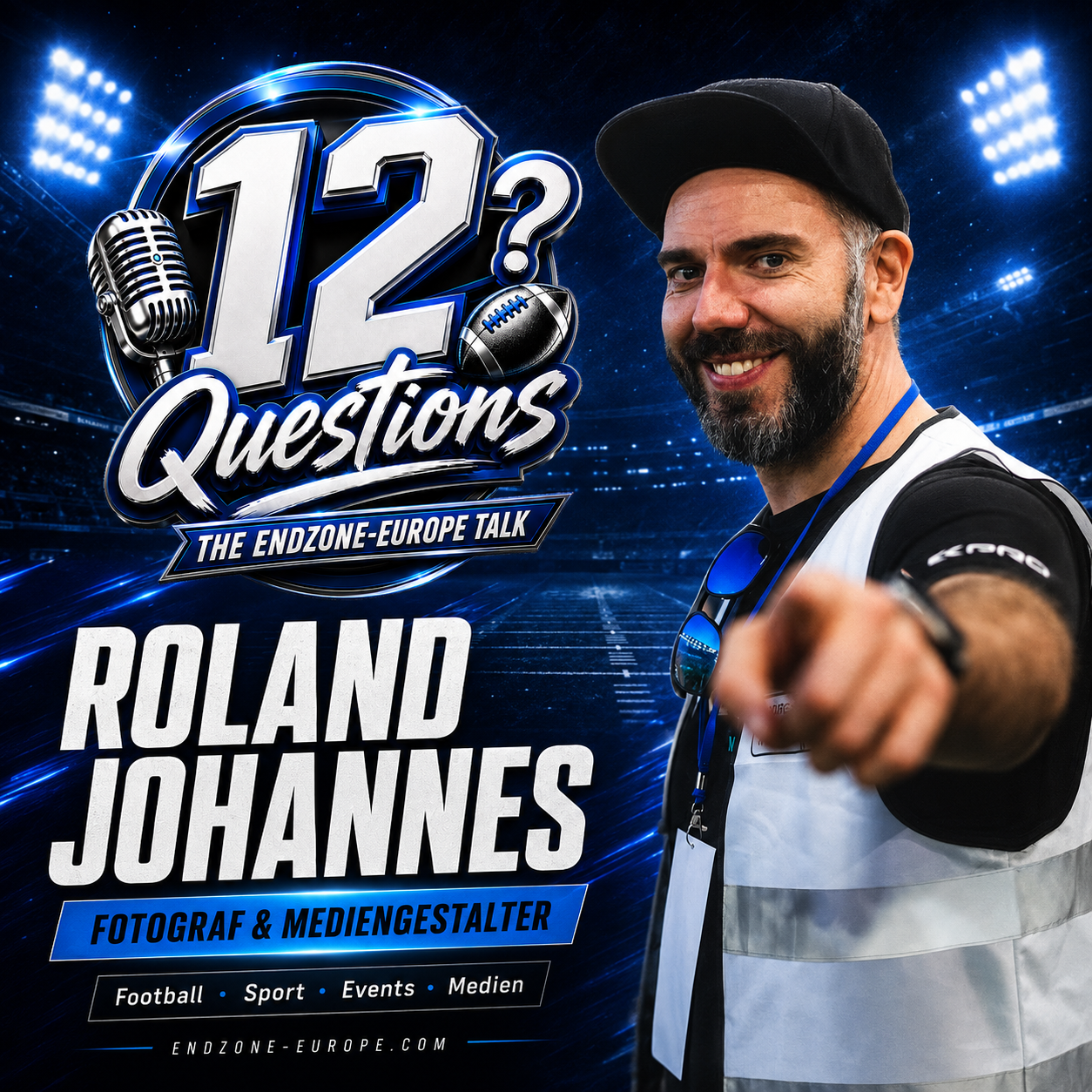
In this interview, Roland Johannes explains how a hobby turned into a professional path through workshops, a trial shooting and the Munich Ravens. He describes why football is especially intense for him as a photographer, how important fans, timing and experience are, and what role photos and videos play in making the sport more visible in Germany.
Roland, you are a photographer, media designer and often right in the middle of the action with your camera. How did you originally get into photography and working with images, film and events?
I got into photography through a lucky coincidence. Working with a camera had always been fun for me, but at first it was only a hobby. It became more professional through several workshops that I attended.
About four years ago, a former colleague took me along to a trial shooting. At that time, a new football team was being founded in Munich and a media team was being put together for it. I took the opportunity, joined the shooting and then became part of the team - and I still am today.
Through my photography work with the Munich Ravens, I also got to know my current employer. Today I have been working as a photographer for four years and, for the past two years, also as a media designer.
What fascinates you most about capturing people, sport and emotions with a camera?
As a child, our family often looked through photo albums together. That was always something special, because it allowed you to remember many beautiful moments and situations - except maybe the baby years.
That is exactly what fascinated me about photography. I want to capture moments that can take people back to that exact instant even years later. Whether it is football, a concert or another special event.
I also like giving people the chance to be part of moments they could not attend themselves. A good photo can carry emotions and tell stories without needing many words.
Your profile shows many powerful moments from sport, events and football. What makes American football especially exciting for you as a photographer?
What fascinates me most about football is the intensity and the closeness to the action. You are often right in the middle of it rather than just watching - close to the players, close to the field and close to the emotions.
I have also tried other sports such as soccer or volleyball. That was fun as well, but with football I feel I can capture the emotions and intensity of the game even better. The joy after a touchdown, the disappointment after a loss or the tension before the next play - all of that happens right in front of the camera.
On top of that, I have been a big football fan for many years. Like probably many others, it started for me with the Super Bowl. Interest quickly became passion. Today I am lucky enough not only to follow this sport, but also to document it through photography.
Football is driven by physicality, speed, emotion, fans and small details on the sideline. What do you pay special attention to during a football shooting?
I mainly focus on variety. Sometimes I get very close to capture emotions - joy, disappointment, tension or even anger. Then there are shots that show a play or the entire field with all its details.
And of course we must not forget the fans. Without the fans, football would be only half as emotional. They are just as much part of the story of a game as the players on the field.
I think that when you include all of these ingredients, you create a really good cocktail, figuratively speaking. The mix of emotion, action, atmosphere and people is what turns a photo series into something you enjoy looking at.
Many fans only see the final picture. How much preparation, timing and experience goes into a really good sports photo?
In the end, a lot comes through experience. The more games you shoot, the more confident you become and the better you understand what matters. But some of the most important things are the mistakes you make at the beginning. You often learn the most from them, even if that does not always happen in the most pleasant way.
When I look back at my early days and see the photos from that time, I often ask myself who actually took those pictures. Only with time do you notice how much you have developed.
Eventually you also develop a feel for the right moment. You learn to judge situations better and often recognize before a play when something special might happen.
You also work in film, events and media production. How does your work with moving images differ from classic photography?
There is always the discussion about what is better: photo or video. For me, both have their place and their strengths.
I am lucky that my job allows me not only to take photos, but also to work a lot with moving images and live productions. I have found that it is often even more difficult than photography to catch the right moment in order to tell a story.
With a film, you want to tell stories; with a live production, you want to provide information and reach people. That is exactly what makes it exciting for me.
I love my job because it is incredibly varied. No day is the same and you constantly learn something new. Many things I learn in film and live productions help me in photography - and the other way around.
What role do photos and videos play, in your opinion, when it comes to making football in Germany more visible and bigger?
I think it is incredibly important. Football is a national sport in the United States, while in Germany it is still much smaller than, for example, soccer. That makes it even more important to reach as many people as possible and show them what an amazing sport football is.
The more people you reach, the greater the chance of making the sport more visible. I believe football is still unfamiliar to many people because they did not grow up with it. As a child in Germany, you were usually sent to play soccer. My parents probably would not have taken me to football either - partly because the sport was not that well known, and partly because the opportunities were simply not as visible as they are today.
That makes it even nicer for me to see how football has developed in recent years and how many new fans the sport has gained. Sometimes I wonder whether one or two of my pictures may have contributed a tiny part to that. And that is a nice thought.
Is there a moment, a game or a football shooting that has particularly stayed in your mind?
The Munich Game 2024 immediately comes to mind. Back then I had the opportunity to photograph as a team photographer for the Carolina Panthers. It was one of the biggest moments of my career so far and also helped me grow enormously in sports photography.
I still think back to that day with great pleasure and I am very grateful that I got that chance. It was not only a special experience, but also a moment that changed my professional life a little bit.
You are based in Munich and close to the regional sports and football scene. How do you experience the development around football, fans and media in Munich?
First of all, a small confession: I am originally from beautiful Saarland and moved to Munich about 15 years ago. So by now I am almost naturalized here.
I have been watching the development of football in Munich for around four years now, and what has happened in that time is really impressive. You see more advertising in the city, more and more people wearing team merch, and suddenly a highlight clip from the last game is playing on the tram. These are often small things, but exactly those moments show how much the sport has grown.
It becomes especially clear on gamedays in the stadium. When you see how many people are there now and what kind of atmosphere there is, the development is very obvious.
Munich has more than one football team, and that is why unity among everyone is important. Especially at the beginning, I sometimes had the feeling that people saw each other more as rivals. That makes me even happier to see that more and more people are now pulling in the same direction. In the end, everyone benefits from that, and only that way can the sport continue to grow.
What makes a good sports photo for you: technique, closeness, emotion, storytelling - or a mix of everything?
Clearly, it is the mix of everything. It does not help if I take a technically perfect picture but it does not carry any emotion.
For me, an image becomes special when you can feel the story behind it. When you look at it and understand what happened in that moment or how the person felt. That is exactly what makes a good sports photo for me.
I also believe that you only develop this eye over time. Experience plays a big role. And sometimes, in the end, it is the so-called lucky shots that you cannot plan and that become something very special.
When you look at the future of European football, what needs to happen for the sport to be presented in an even more professional and attractive way in the media?
I think we could learn quite a few things from the Americans and transfer some of them to Germany. Often it is not even the big things, but missing information or a lack of visibility that make the difference.
The more people you reach through media, the greater the chance that they become interested in the sport and discover it for themselves. But this is a marathon, not a sprint. The development of recent years shows that the current path is the right one.
What matters now is not losing courage and continuing consistently. The more visible the sport becomes, the more people will be able to get excited about it. That is why I believe the motto in the end is: more helps more.
If we continue on this path, I see a very bright future for football in Germany and in Europe.
To finish: when people look at your images and your work later on, what should they recognize or feel in them?
That is a very nice question.
I would like people to recognize the idea and the story behind my images. Maybe, as I mentioned earlier, they can be taken back into a certain moment or feel something they connect with that instant.
That is exactly what makes a good photo for me. It does not just capture a moment, it also tells a story.
And who knows, maybe one day my pictures will hang in an exhibition and tell their own stories there.
Many thanks to Roland Johannes for his open insights into photography, media production and football. His answers show how important images, videos and real emotion are for the development of the sport - on the field, on the sideline, in the stadiums and for everyone who discovers football through these stories.