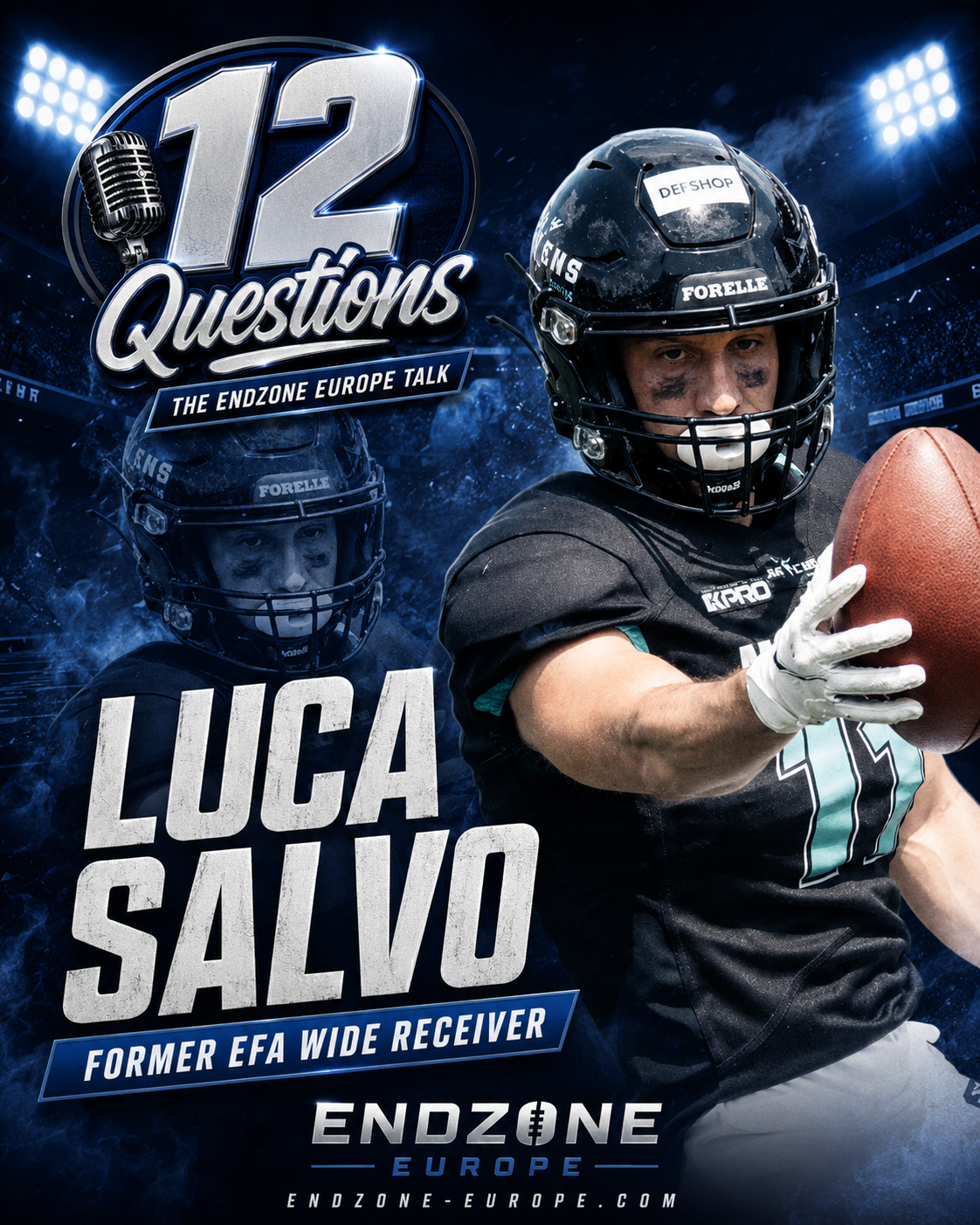
From his first steps in football to the GFL, the dream of the United States and becoming #11 of the Munich Ravens: Luca Salvo looks back openly on his development. He speaks about 7,000 fans at the Ravens’ first home game, more professional structures, the special connection between receiver and quarterback, and what he misses most after retirement.
Luca, many people know you as #11 of the Munich Ravens. Looking back on your football journey today, which moment shaped you the most?
The moment that shaped me the most was probably in 2019. After only one year of playing football, I was already able to help out in the GFL. That was when I realised I was better than I had believed possible at that point.
From then on, the dream was to become as good as I possibly could and compete with the best.
You are from Munich, played for the Munich Cowboys and later for the Munich Ravens. What does it mean to you to have experienced and helped shape football in your hometown?
Representing Munich is always special to me. I am very happy to live here and to have played football for Munich.
There were also times when you would have liked to move elsewhere, but that had nothing to do with the city. :)
You developed from the Munich Cowboys pathway to the top level of European football. Looking back, what was the biggest step in your development as a wide receiver?
I think the biggest step was going to the United States to attend college, even though it only worked out to a limited extent for me in the end.
I fought for two years just to receive an offer. Joining the Ravens was then the final major step. Proving myself to Coach Shoop and earning the chance to play was also very hard.
Wide receiver is a position where technique, timing, explosiveness and trust with the quarterback all come together. What did you enjoy most about the role?
Using my athleticism to trick a defender and send him in the wrong direction was always what I enjoyed most.
Catching the ball at full speed is the next art, of course, but the route to that moment and the one-on-one battle with a defender were always the best part for me.
You could also immediately feel when the relationship with the quarterback was right – and just as clearly when you were not quite on the same wavelength.
The Munich Ravens became a highly visible football project in Munich within a short time. How did you experience the team’s development from the inside?
Preparation for the first game was initially pure survival: would you make the roster or not?
Then you slowly noticed the promotional campaign gaining momentum, and we expected a decent number of people in the stadium. Suddenly, 7,000 people were standing there cheering for you even though you had not achieved anything in the league yet. It was completely surreal.
That was when you realised the Ravens had done a lot of things right. Looking at how the organisation has developed since then, an incredible amount has changed.
It started with a tiny office that could hold no more than two people. Today there is a proper headquarters. Players can come in for treatment, there are meeting rooms, the coaches have offices and the entire staff works on site.
That was a clearly visible difference.
What was the biggest difference for you between GFL football and the level or environment with the Munich Ravens?
I noticed the difference immediately in my first year. Before that, I thought it could not be that significant because many of the same players had previously played in the GFL.
Most teams, however, had better facilities and training conditions. Players could be paid, many reduced their working hours and some no longer had to work alongside football at all.
That naturally allowed a stronger focus on football. More professionalism was expected from us, but we were also given a more professional environment.
The contact on the field was not necessarily harder, but everything was faster. Tackles arrived faster, routes had to be run faster and the ball came faster as well.
When a player ends his active career or takes a new direction, his view of the sport often changes. What has that transition felt like for you?
My view of the sport has not changed since the end of my career. But I miss it every single day.
Stopping is still very difficult for me.
What does a player probably miss most: gameday, the locker room, preparation, the guys – or something completely different?
I miss pursuing the same goal with 70 people and doing everything physically and mentally possible to achieve it.
Thinking about football seven days a week and playing the sport: the training, the guys, the games – basically everything you can think of.
I probably miss the guys most of all.
You also gave people insight into your football life through social media and YouTube. How important is it for European players to tell their own stories?
It was never important to me to tell the story specifically from a European perspective. I simply wanted to give other people insight and perhaps inspire them.
I think that worked quite well, even though unfortunately I no longer had time for it during the final year and a half of my career.
European football is going through major change. What is going well in your opinion, and what must improve for the sport to grow sustainably?
It is a real shame that there are now only two B leagues and no major A league.
We absolutely need to find a solution for that.
What role would you like to have in football or around the sport in the future – on the field, in media, coaching, the community or somewhere else?
In my mind, I am still a player.
I would also really like to become a coach one day, but at the moment I do not have enough time either for that or for a return as a player.
So on gamedays I move around here and there and offer my “expert opinion” on television.
When fans look back on your playing career in the future, what should the name Luca Salvo stand for?
That is something I cannot control myself.
But it would be nice if my name could bring a smile to people’s faces and remind them of good memories.
Many thanks to Luca Salvo for his open and personal answers. His interview shows how quickly a first year in football can turn into a major dream – and how deeply the bond with a team, teammates and the sport remains even after a playing career ends.